
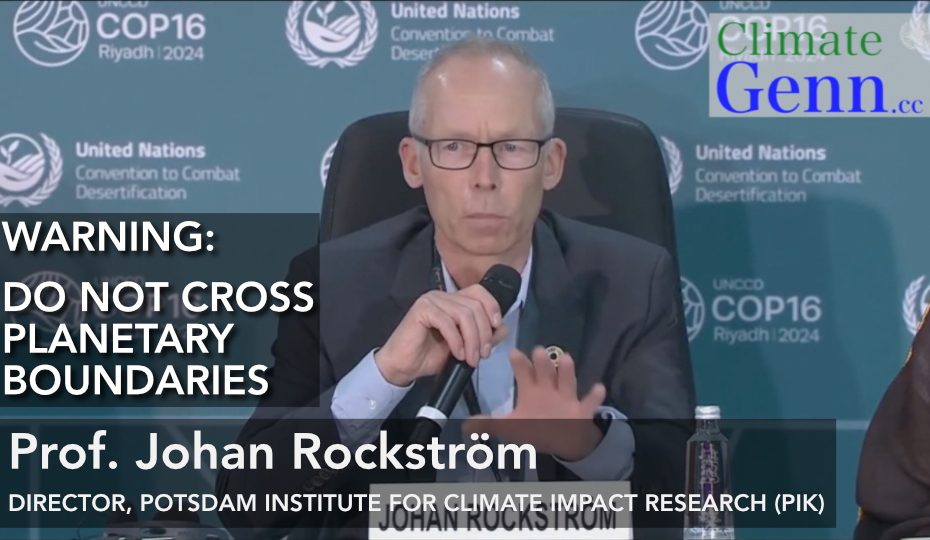

Director of Potsdam Institute for Climate Impact Research (PIK) issues urgent warnings to stay within panetary boundaries by using this decade to get back on track to safe planetary health as new report by PIK released at COP26 Riyadh.
(0:00 – 0:20)
Scientifically, we can be very clear today in our communication to the world at large, but also to those gathered here at COP16, that we are following a very dangerous path. We are at a critical juncture. For the first time, we need to consider the real risk of destabilising life support on the entire planet.
(0:21 – 0:42)
We’re following, as you know, a pathway that will take us, in terms of global warming, to over 3 degrees Celsius over just the next 75 years. This is a pathway that unequivocally leads to disaster. There’s absolutely no scientific evidence that we can support a world population under such conditions.
(0:43 – 1:22)
An environment on planet Earth we haven’t seen for the past 4 million years. But the following is the key message, I would argue, when we gather here at the UNCCD, that land is a fundamental precondition that will determine whether or not we can turn this around, or whether we will continue towards potentially even a self-reinforced, unstoppable pathway towards even worse warming levels. How can I say this? Well, it’s because we know that land is connected to 7 of the 9 planetary boundary systems that regulates the life support, the resilience, and stability of the planet.
(1:22 – 1:43)
It’s directly regulating to climate change, to biodiversity loss, to freshwater stability, to the cycles, what we call the biogeochemical cycles of nitrogen and phosphorus, to the air pollutants, and to chemical loading. And these are 7 of the 9 planetary boundaries. So fix land, and we have a good chance of keeping the planet in a healthy state.

(1:44 – 2:18)
If we continue losing, as Ibrahim Chow pointed out, if we continue losing 1 million square kilometres of healthy land each year, we’ll be sliding even further down a negative path. Think of this also as if we’re sitting on a balancing teeter, and the numbers are today at a very, very scary level. Because on one side of this teeter, we know that unsustainable land management, the way we manage agriculture, forestry, and land use, is the single largest emitter of greenhouse gases in the global economy.
(2:18 – 2:45)
Roughly 23%, somewhere between 20% and 25% of emissions. On the other side of this balancing teeter, you have intact nature, which actually is absorbing roughly the same amount, in the order of 25% of carbon dioxide. So currently, we are at this point where the planet is just balancing between sliding in the wrong direction, but trying to help us to keep ourselves away from danger.
(2:45 – 3:06)
But for every day we lose more intact land, we lose that capacity, and the teeter starts falling over, and we’ll start sliding in the wrong direction. That’s the biggest scare we have today. Of the six of the nine planetary boundaries that are breached, that are outside of the safe levels, all of them are connected to land.
(3:06 – 3:31)
This is what we have shown in a report that was commissioned by the UNCCD, led by the Post Office of Climate Impact Research, and launched publicly here in Riyadh today. We’ll have an official side event on Wednesday on this. So land is associated with breaching the climate boundary, the biodiversity boundary, the freshwater boundary, the nitrogen-phosphorus boundaries, and, of course, the land boundary itself.
(3:32 – 3:48)
This is, as was also pointed out by my fellow co-president here, not only about droughts and desertification. I agree with Ibrahim that this is a top priority of building drought resilience, but it’s for all citizens in the world. It is the boreal forest in Canada.
(3:49 – 3:55)
It is the fires today we see in the Arctic region. It’s the temperate forest in Europe. It’s the rainforests.
(3:55 – 3:59)
It’s the arid lands. It’s the savannas. All systems are under pressure.
(4:00 – 4:18)
This report, to close, focusses on transformation pathways. What are the solutions? What can we do in terms of policies in meetings like this? It is about stopping the expansion of agriculture and infrastructure into intact land. That’s like the first step to take, no more expansion.
(4:19 – 4:39)
What happens here in Riyadh is therefore a critical factor to support the Global Biodiversity Framework, but also to support the Paris Climate Agreement, because unless we can stop that expansion, it doesn’t matter if we phase out coal, oil, and gas. We will still breach the Paris limit of 1.5 degrees Celsius. Land can breach that on its own.
(4:39 – 4:56)
If we do not get success in Riyadh, we cannot meet the Global Biodiversity Framework. Land can on its own make us fail the UNCBD. So we’re sitting here in a very decisive moment, but we’re also exploring in this report, to close, Ibram Chow’s point about finance.
(4:56 – 5:33)
This is an area where we need major, major efforts in investing in regenerative agricultural land use practises, but also in conserving and protecting natural lands and investing in drought resilience, which is absolutely necessary, because there will unavoidably be more droughts and more severe droughts in the coming decades. Thank you. My question is following the partial failures of COP16 biodiversity and the negotiation on plastic in Busan, I wanted to know how confident you are that the outcome of this COP will be positive.
(5:34 – 5:55)
Just to, in a way, repeat, in other words, what I said earlier, how much that is at stake, that the UNCCD gathering here in Riyadh does not have much choice. We are almost halfway into what science today calls the decisive decade of humanity’s future on Earth. That sounds very dramatic.
(5:55 – 6:11)
It’s not as if we must solve everything by 2030, but we must bend the curves, and we must be decisively on our way back to a safe landing. And so far, we’re not making any progress. And correct, the CBD meeting in Cali did not make the progress we had expected.
(6:11 – 6:44)
The plastic discussions, neither. I would even argue that Azerbaijan did not deliver as we needed to see in terms of the transitioning away from fossil fuels and get decisive agreements on finance for climate action. Here is an opportunity for land, as the glue between all these conventions, to show the direction forward, because the land agenda is sitting not only with solutions to a problem, but also with solutions towards a better outcome for prosperity, equity, and livelihoods.
(6:44 – 7:11)
So this is, I think, a very pivotal moment for Riyadh to really deliver. Professor Rockström, anything in particular on the atmospheric water generation that you might have an opinion on? For every 1 degree Celsius of warming, we add physically 7% moisture-holding capacity in the atmosphere. So more warming, we power up the hydrological cycle, we get more rainfall.
(7:11 – 7:25)
That could sound like a good message, but unfortunately, it leads to just more extremes. More extreme downpours, more droughts, more floods. It doesn’t pour down in any even way.
(7:26 – 7:51)
That is caused by us humans. If we go in addition to that and add even more investments in moisture engineering, very likely there are unexpected secondary impacts that would put that hydrological cycle even more out of balance and cause even more extremes. And moreover, it can destabilise the system so that you have one winner, but many, many other losers downwind.
(7:52 – 8:10)
So I think what science tells us today, even though the jury is slightly out what could be accomplished, is that the precautionary principle tells us that this should be not on the table. We should not support that kind of scaling of water engineering.