
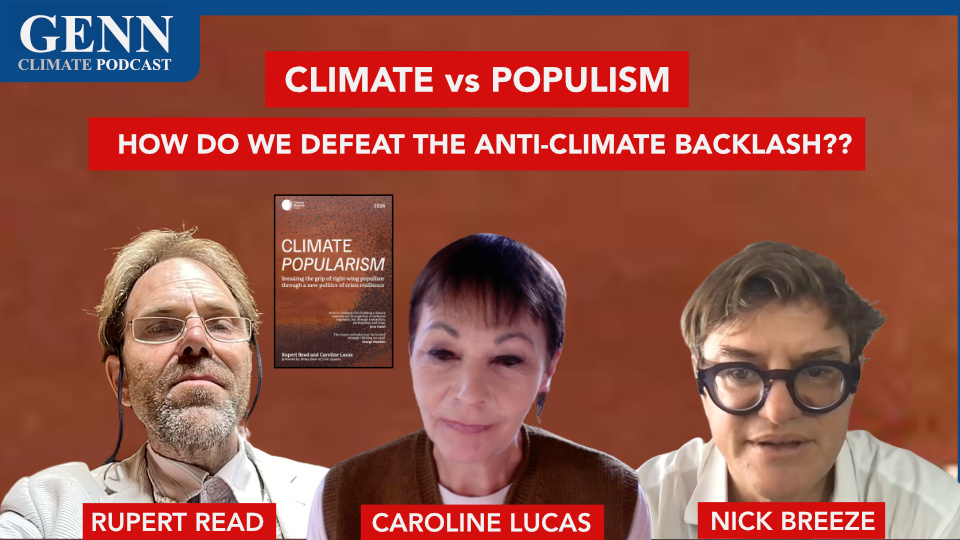

Why has protecting our climate become politically controversial? Former Green Party leader Caroline Lucas and climate philosopher Rupert Read join the GENN Podcast to discuss how climate action can reconnect with the concerns of ordinary people.
Climate change is increasingly visible in our daily lives, from extreme weather and food insecurity to rising costs and growing concerns about the future. Yet climate action has become a target of political backlash, with environmental policies often presented as threats to household finances and personal freedom.
In this episode of the GENN Podcast, Nick Breeze speaks with Caroline Lucas, former Green Party MP and leader, and Rupert Read of the Climate Majority Project about their report, Climate Popularism.
The discussion explores how the climate movement can move beyond technocratic language, political polarisation and abstract targets to build a broader public conversation about security, affordability and resilience.
Watch the interview
How did climate action become unpopular?
Caroline Lucas begins with a fundamental question: how has protecting our own lives, livelihoods and families come to be regarded as an unpopular political cause?
Further reading: Climate Popularism — Climate Majority Project (PDF)
The discussion examines the gap between public concern about climate change and the way climate policy is communicated. Too often, the debate is framed around costs, restrictions and distant targets rather than practical improvements to people’s lives.
The challenge, Lucas and Read argue, is not simply to communicate climate science more effectively. It is to make climate action relevant to the immediate concerns of communities.
Moving beyond the language of net zero
Rupert Read questions whether terms such as net zero have become obstacles to public understanding.
Although emissions targets remain important, technical language can obscure the everyday benefits of climate action, including warmer homes, lower energy bills, healthier neighbourhoods and greater resilience to extreme weather.
The conversation explores how a different political and cultural approach could make climate action more accessible to people who do not identify with the environmental movement.
Climate security, affordability and community resilience
The interview also examines how climate action intersects with the cost of living, food security and local communities.
Rather than treating environmental protection as a separate political issue, Lucas and Read discuss how it can be connected to practical priorities: making homes more efficient, strengthening local resilience and ensuring communities have a meaningful role in decisions affecting their futures.
Examples of community-led initiatives and democratic participation illustrate how climate action might become something people help shape rather than something imposed upon them.

Can climate politics reach beyond its traditional supporters?
One of the central challenges explored in Climate Popularism is how to engage people who feel alienated by mainstream climate politics, including those attracted to parties campaigning against environmental policies.
The discussion considers political language, public trust and the need to listen to people’s genuine concerns without abandoning the scientific realities of climate change.
It also addresses the emotional dimension of the crisis, including climate anxiety, grief and the importance of maintaining a sense of agency.

A new approach to climate communication
The conversation raises a question for politicians, campaigners, journalists and the wider public: can climate action become a popular movement rooted in everyday needs and shared interests?
Lucas and Read suggest that a successful response to the climate crisis will require more than scientific evidence and government targets. It will also depend on public participation, practical benefits and a compelling vision of a safer future.
Watch the full GENN Podcast interview above and explore the Climate Majority Project’s report below.
Further reading: Climate Popularism — Climate Majority Project (PDF)
Watch on YouTube: Caroline Lucas and Rupert Read — Climate Popularism