


The Copernicus Climate Change Service (C3S) has confirmed that 2024 was the warmest year globally, marking the first time the average global temperature exceeded 1.5°C above pre-industrial levels. C3S, implemented by the European Centre for Medium-Range Weather Forecasts (ECMWF) on behalf of the European Commission, has been meticulously tracking climate indicators throughout the year. The primary driver of these unprecedented temperatures is human-induced climate change, although the El Niño Southern Oscillation (ENSO) also played a role.
Focus on Coordinated Climate Monitoring
In a significant collaborative effort, organizations including ECMWF, NASA, NOAA, the UK Met Office, Berkeley Earth, and the World Meteorological Organisation (WMO) synchronized their data releases, emphasizing the extraordinary climatic conditions experienced in 2024.
“The future is in our hands – swift and decisive action can still alter the trajectory of our future climate.”
Carlo Buontempo, Director of the Copernicus Climate Change Service, ECMWF

Focus on Global Surface Air Temperature
2024 set a new record as the warmest year since global temperature recording began in 1850. The global average temperature reached 15.10°C, surpassing the 1991-2020 average by 0.72°C and 2023 by 0.12°C. This figure represents a 1.60°C increase over the 1850-1900 pre-industrial baseline. Notably, the global average temperature exceeded 1.5°C above pre-industrial levels for 11 months of the year. A record daily global average of 17.16°C was recorded on 22 July 2024.
Every month from January to June 2024 was warmer than corresponding months in previous years. The year saw three record-warm seasons, including boreal winter, spring, and summer, each significantly above the 1991-2020 average.
Focus on Ocean Surface Temperature
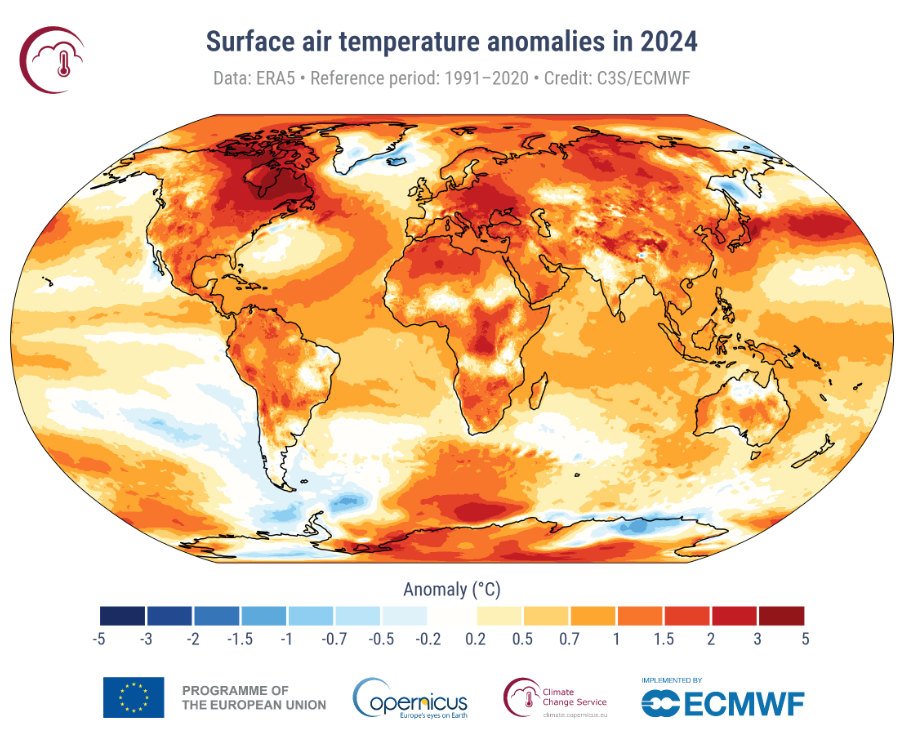
The annual average sea surface temperature (SST) in 2024 over the extra-polar ocean hit a record high of 20.87°C, which is 0.51°C above the 1991-2020 average. Record high levels were observed from January to June, continuing from the second half of 2023. The El Niño event of 2023 concluded, transitioning towards neutral or La Niña conditions.
Focus on European Temperatures
Europe also experienced its warmest year on record, with an average temperature of 10.69°C, 1.47°C above the 1991-2020 reference period. Both spring and summer 2024 shattered previous seasonal records.
Focus on Atmospheric Water Vapor and Heat Stress
In 2024, the atmospheric water vapor reached a record 5% above the 1991-2020 average. This increase contributed to higher levels of heat stress across much of the Northern Hemisphere, with 44% of the globe experiencing at least ‘strong heat stress’ on 10 July 2024, a record maximum.
Focus on Polar Ice Extent
Antarctic sea ice extent remained alarmingly low, with record or near-record low values throughout much of 2024. In contrast, Arctic sea ice extent stayed near average until July but dropped significantly below average in subsequent months, ranking fifth lowest in the satellite record by September.
Focus on Greenhouse Gas Concentrations
Atmospheric concentrations of carbon dioxide and methane reached record levels in 2024, with CO2 at 422 parts per million (ppm) and methane at 1897 parts per billion (ppb). These figures represent year-on-year increases of 2.9 ppm for CO2 and 3 ppb for methane.

“We are now teetering on the edge of passing the 1.5ºC level defined in the Paris Agreement and the average of the last two years is already above this level. These high global temperatures, coupled with record global atmospheric water vapour levels in 2024, meant unprecedented heatwaves and heavy rainfall events, causing misery for millions of people.”
Samantha Burgess, Strategic Lead for Climate, ECMWF
Urgent Action Needed to Combat Climate Crisis
The 2024 climate data is a stark warning to global policymakers: carbon emissions must be drastically reduced to combat the escalating climate crisis. With 2024 being the warmest year on record and the first to surpass 1.5°C above pre-industrial levels, the urgency for action has never been greater.
Rising global and ocean temperatures, shrinking polar ice, and increased atmospheric water vapor signal the beginning of more severe and unpredictable weather patterns. Wildfires are intensifying, threatening lives and property, as the planet heats up. The continued rise in carbon dioxide and methane levels highlights the need for immediate and decisive policy changes to prevent further environmental and societal catastrophes.